Written By Mauricio Segura // Image Created By: The Golden Bay Times Graphics Dept.
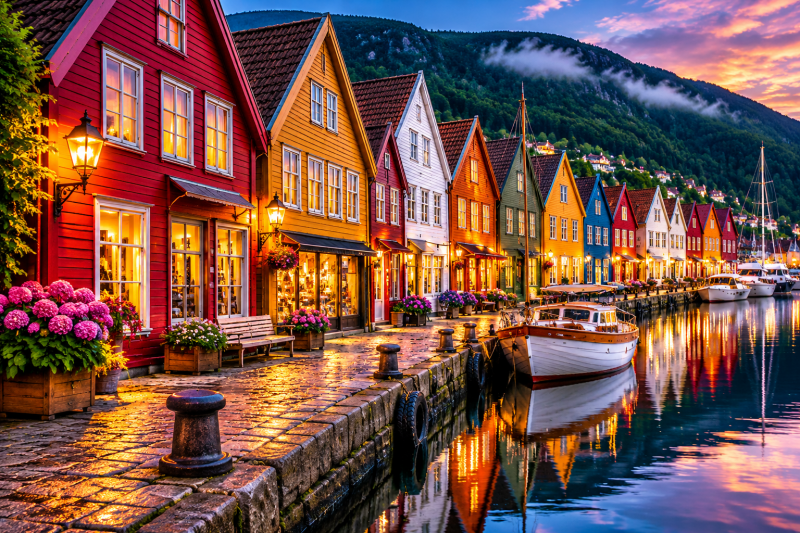
Along Norway’s western coast, a row of colorful wooden buildings stands shoulder to shoulder beside Bergen’s busy harbor. Painted in shades of red, yellow, white, and brown, their steep rooftops and narrow fronts look almost too charming to be real. But these buildings are no carefully designed movie set. They belong to Bryggen, a centuries-old waterfront neighborhood that has survived devastating fires, changing fortunes, and the passing of generations. Behind those famous wooden walls lies a remarkable story of international trade, medieval life, and a city determined to preserve its past.
Bergen has been an important trading center since the Middle Ages, but its waterfront gained international influence when merchants from northern Germany established a powerful trading community there. During the 14th century, the Hanseatic League, a network of merchant cities and trading organizations across northern Europe, made Bergen one of its major commercial outposts. By controlling much of the trade in dried fish from northern Norway, these merchants helped turn the harbor into one of Europe's important trading centers.
Their most valuable product was hardly glamorous. Stockfish, usually cod dried naturally in the cold northern air, became an important export throughout Europe. German merchants exchanged grain and other goods for Norwegian fish, creating a commercial relationship that lasted for centuries. What might seem like an ordinary fishing industry today helped support an international trading network long before modern shipping containers and supermarkets existed.
Life at Bryggen was far from luxurious. The German merchants formed a largely male community, living and working in tightly packed wooden buildings. Narrow passageways connected living quarters, offices, and warehouses, while goods moved between the waterfront and storage rooms. The buildings were arranged in long rows stretching back from the harbor, a layout that visitors can still recognize today.
There was, however, one serious problem with building an entire commercial district from timber. Fire could destroy years of hard work in a matter of hours.
Bryggen suffered repeated fires, including a disastrous blaze in 1702 that devastated Bergen. Rather than abandon the waterfront, residents rebuilt using traditional construction methods and the earlier street layout. Much of what visitors see today reflects that reconstruction, while the arrangement of the buildings preserves traditions reaching back to medieval times. Another destructive fire struck in 1955, prompting archaeological excavations that uncovered extraordinary evidence of Bergen’s earlier inhabitants.
Those discoveries revealed an everyday world far more interesting than simple trading records. Archaeologists recovered objects that offered clues about medieval clothing, personal relationships, religious beliefs, and ordinary household life. Some finds included runic inscriptions containing messages, poetry, and even gossip. The past, it seems, had plenty of people with something to say.
Today, visitors can explore these discoveries at Bryggens Museum, built above remains of some of Bergen’s earliest structures. Its exhibitions bring the medieval city to life through archaeological objects and research. Nearby, the Hanseatic Museum and Schøtstuene introduces visitors to the merchants who once controlled much of the waterfront's commercial activity. The historic assembly rooms show where members of the trading community gathered for meals, meetings, and important discussions.
Yet Bryggen’s greatest attraction might be the neighborhood itself.
Walking beyond the colorful harborfront reveals narrow wooden passages, historic galleries, small workshops, and unexpected courtyards. Artists, jewelers, and craftspeople now occupy spaces once devoted to merchants and their valuable cargo. Visitors can browse handmade goods, discover local artwork, or enjoy a meal surrounded by buildings whose designs have endured for generations.
The historic district became a UNESCO World Heritage Site in 1979, recognizing its exceptional importance as a surviving example of northern Europe's wooden trading settlements. Approximately 62 historic buildings remain, preserving a rare connection to an age when Bergen played an important role in European commerce.
Protecting them requires constant attention. Timber naturally deteriorates, and the neighborhood faces continuing threats from moisture, fire, heavy tourism, and changing weather conditions. Conservation specialists work to maintain historic materials and construction methods, ensuring that repairs respect the buildings' character rather than simply replacing everything old with something new.
That dedication gives Bryggen something many historic attractions struggle to achieve. It remains a working neighborhood rather than an empty collection of preserved buildings.
Visitors can explore the waterfront throughout the year without paying an admission fee, although museums and organized tours have separate charges. The colorful facades provide memorable photographs, but the quieter passageways behind them reveal something more meaningful.
Bryggen is not remarkable because every wooden board has survived untouched for hundreds of years. It is remarkable because generations of people repeatedly chose to rebuild, repair, and protect a place that mattered to them. Fires destroyed buildings, trade routes changed, and centuries passed, yet the historic waterfront continued to stand.
In Bergen, history has not simply been saved behind museum glass. It still has doors that open, floors that creak, and stories waiting around the next corner.