

Written By Mauricio Segura // Image Created By: The Golden Bay Times Graphics Dept.
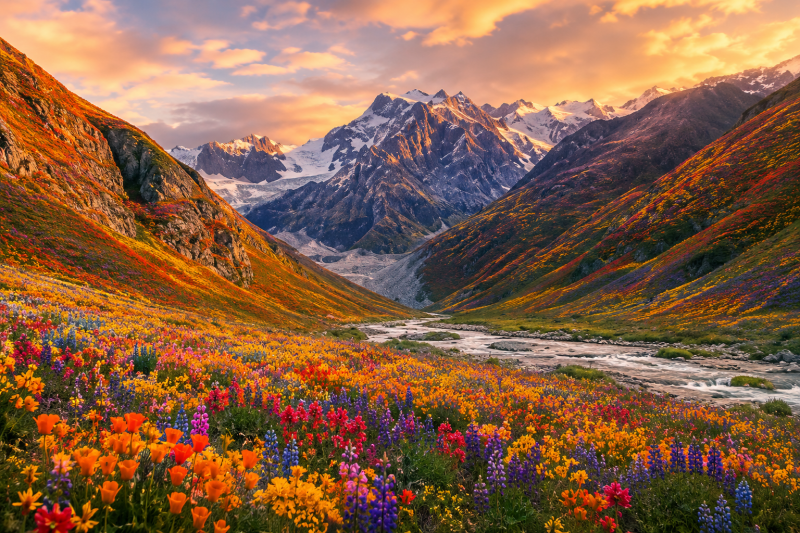
There are places that announce themselves with neon signs, souvenir shops, and parking lots big enough to be seen from space. India’s Valley of Flowers does not bother with any of that. Tucked high in the Himalayas of Uttarakhand, this alpine meadow opens only for a short season, then disappears again under snow and silence. For visitors, that limited window is part of the magic. You do not simply wander into the Valley of Flowers. You plan for it, walk for it, sweat for it, and then, if the weather is kind and your legs behave, the mountains finally let you in.
The Valley of Flowers National Park reopened to visitors on June 1 and is expected to remain accessible until October 31, giving travelers only a few months to see one of India’s most striking natural landscapes. The timing is no accident. The valley spends much of the year locked away by snow, but during the warmer months, especially from July through September, its slopes and meadows burst into color. What looks from a distance like a quiet green bowl becomes, up close, a living carpet of alpine flowers, fed by rain, streams, and Himalayan patience.
This is not a theme park version of nature, polished smooth for easy consumption. The Valley of Flowers sits in Chamoli district and is part of the Nanda Devi Biosphere Reserve. Along with Nanda Devi National Park, it is recognized by UNESCO as a World Heritage Site, praised for its beauty, rare plants, and rich wildlife. That official title matters, but it still sounds a little too tidy for a place that feels more like a secret the mountains agreed to share only briefly.
The journey is half the story. Most travelers make their way toward Govindghat, the gateway for the trek, before continuing toward Ghangaria, the base village used for both the Valley of Flowers and the nearby Hemkund Sahib route. From there, the trail continues into the national park. It is not a casual flip-flop stroll with a paper cup of coffee in hand. The route demands time, energy, and respect for mountain weather. Rain can show up like an uninvited relative, trails can turn slippery, and the altitude has a way of reminding visitors that the Himalayas do not care how many steps they logged on a treadmill back home.
That effort, though, is exactly why the place still feels special. In an age when nearly every beautiful view has been flattened into a phone wallpaper, the Valley of Flowers still keeps some old-fashioned rules. You must arrive during the right season. You must follow the path. You must leave the place as you found it. Overnight stays inside the park are not allowed, which helps protect the fragile ecosystem and keeps the valley from becoming just another over-loved destination.
The reward is not one single postcard view, but a series of quiet surprises. Waterfalls spill down dark rock. Clouds drift low enough to make the mountains seem half-dreamed. Birds move through the damp air. Flowers appear in patches, then clusters, then sweeping fields, with colors that can make even a tired trekker stop pretending they are not impressed. The valley is known for hundreds of plant species, including rare Himalayan blooms, and the wider protected area is also habitat for animals such as the Asiatic black bear, snow leopard, brown bear, blue sheep, and musk deer.
Nearby, travelers often add Hemkund Sahib, a high-altitude Sikh pilgrimage site, or continue toward other spiritual and scenic destinations in Uttarakhand. But the Valley of Flowers has its own mood. It is not loud. It is not trying to sell itself. It is the kind of place that feels more powerful because it does not last all year. Like spring blossoms, baseball season, or a good bakery before noon, the short window makes the experience sharper.
That may be the real lesson hidden in the meadow. Some beauty is not improved by convenience. Some places are better because they make people slow down, prepare, and arrive with humility. The Valley of Flowers is not just a destination. It is a reminder that the world still has doors that open only at the right time, and only for those willing to climb toward them.


