

Written By Mauricio Segura // Image Created By: The Golden Bay Times Graphics Dept.
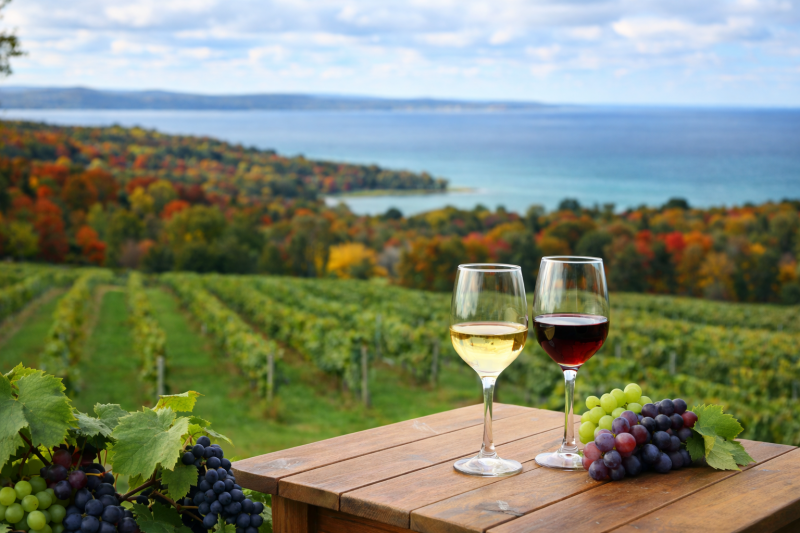
There was a time when northern Michigan was better known for cherries than cabernet. Rows of orchards stretched across rolling hills, feeding a regional identity built on pies and summer harvests. Then something changed. Quietly, almost stubbornly, this stretch of land along Grand Traverse Bay began producing wines that could stand shoulder to shoulder with far more famous regions. Today, the Traverse Wine Coast has emerged as one of America’s most surprising and rewarding wine destinations, and it is doing so without the pretense or crowds that often come with big-name wine country.
Set along the narrow Old Mission and Leelanau peninsulas that frame Traverse City, this region now boasts more than 40 wineries, a remarkable transformation in just a few decades. What makes that growth even more impressive is the climate. Winters here are no joke, often dumping heavy snowfall that would seem to crush any hopes of delicate grape cultivation. But nature has a trick up its sleeve. The deep waters of Grand Traverse Bay act like a natural thermostat, protecting vines from spring frost and stretching the growing season just enough for European grape varieties to ripen.
That balance is everything. It allows winemakers to focus on cool climate grapes like riesling and cabernet franc, which thrive under these conditions. The result is wine that feels alive in the glass, bright, crisp, and often surprisingly complex. This is not the bold, sun soaked heaviness of California reds. This is something more restrained, more nuanced, and arguably more reflective of the land itself.
Geography plays its part beyond the water. The region sits along the 45th parallel, a line it shares with some of the most respected wine producing areas in the world. Add in glacial soils and rolling terrain shaped thousands of years ago, and you have a natural foundation that winemakers are eager to explore. It is not just about growing grapes. It is about expressing a place.
And that sense of place hits you immediately when you arrive. Vineyards here do not just stretch into the distance. They fall toward the water, offering sweeping views of blue bays that look more like an ocean than a lake. Tasting rooms are often perched on hillsides, where a glass of wine comes with a breeze off Lake Michigan and a horizon that refuses to end. It feels less like a production line and more like a personal invitation.
Traverse City itself adds another layer to the experience. Known as the Cherry Capital of the World, it still holds onto its agricultural roots while embracing its growing reputation as a food and wine destination. Restaurants lean heavily into local ingredients, pairing dishes with wines that were likely produced just a few miles away. It creates a seamless connection between farm, vineyard, and table that larger regions sometimes struggle to maintain.
There is also a certain humility to the Traverse Wine Coast. Unlike Napa or Sonoma, where prestige can sometimes overshadow the experience, this region feels accessible. You can drive from one winery to another without fighting traffic. You can talk to the people pouring your wine and often discover they are the same ones who helped make it. There is pride here, but it is grounded, not performative.
That authenticity is part of what is drawing attention. Northern Michigan’s wine and food scene has been gaining national recognition, with chefs and winemakers pushing boundaries while staying rooted in the region’s identity. It is not trying to imitate anyone else. It is carving out its own lane, one bottle at a time.
The Traverse Wine Coast is not just a place to drink wine. It is a place to understand it. To see how climate, geography, and patience come together to produce something worth savoring. It is a reminder that great wine does not always come from the places you expect. Sometimes it comes from a shoreline shaped by glaciers, guarded by deep blue water, and built on a quiet belief that something special can grow where no one thought it could.
And when it does, it is worth the trip.


